Anders Behring Breivik was influenced by the writing of a third-rate U.S. terrorism “expert.”
Breivik’s Qutb
read more

Anders Behring Breivik was influenced by the writing of a third-rate U.S. terrorism “expert.”

In October 2010, I took my car to my mechanic in Santa Clara for an oil change. As the mechanic was elevating the car on the hydraulic lift, I noticed that there was something like a piece of string or wire coming out from the back. Then, when the car was fully elevated, I noticed this black device under the back of the car. I asked the mechanic to pull it out, and he handed it to me. He was somewhat freaked out.
Only recently, the Obama administration leaked news that it wasintensifying its military-run war against al-Qaeda in Yemen by bringing the CIA into the action. The Agency is now to build a base for its drone air wing somewhere in the Middle East to hunt Yemeni terrorists (and assumedly those elsewhere in the region as well). Yemen functionally has no government to cooperate with, but in pure Bushian fashion, who cares?
If the Shining Path is permitted to reconstitute itself as either a political movement or a drug trafficking outfit, new Peruvian President Ollanta Humala will almost certainly guarantee himself a legacy of failure.
Perhaps it’s time we sympathized with what drives suicide bombers.

In his new book, Feeling Betrayed: The Roots of Muslim Anger at America, political psychologist and public opinion expert Steven Kull suggests that the reservoir of Muslim discontent with U.S. foreign policy remains as deep as it ever was. He argues that al-Qaeda, like any terrorist group, is able to operate in part because it can draw on a culture of support from within its broader community. Although they may have sharp qualms about al-Qaeda’s methods and its extreme form of Islam, many Muslims in Muslim-majority countries are drawn to defend the group’s resistance to the United States.

On August 28, 2008, two childhood friends from Midland, Texas, Bradley Crowder and David McKay, traveled north to join thousands of protesters at the 2008 Republican National Convention (RNC). In the company of six Austin activists, Crowder and McKay were ready for adventure, and prepared, in Crowder’s words, to protest to “change the world.” What began as a journey of hope, however, ended in sudden catastrophe.
“Every time civilians are killed, you almost always do more harm than good,” agreed Carnegie’s Boucek. “You turn off the Yemeni people from wanting to co-operate; you turn off the government, because it looks like they’re facilitating it. It breeds further radicalization and makes it appear that Americans only care about terrorism, which is a pretty small issue compared to the challenges that Yemen faces and that lead to state failure or collapse,” he added.
Some in India see the U.S. attack on the Bin Laden compound as a chance to address their inferiority complex about their country being “soft.”
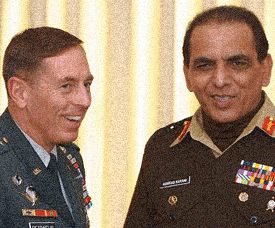
In order to keep his job, Pakistani army chief Gen. Ashfaq Kayani may read the riot act to the United States about its drone program.